
If you are having thoughts of harming yourself or your baby, call or text 988 (Suicide & Crisis Lifeline) or go to the nearest emergency room. If you need to talk to someone about treatment right now, Recover Now’s admissions line is open 24/7 at (205) 533-6509.
You were told this would be the happiest time of your life. Instead, you feel hollow, or on edge, or like you’re watching someone else hold your baby. You haven’t slept a full stretch in weeks, you cry at things that shouldn’t make you cry, and a quiet voice keeps insisting that everyone would be better off without you. You’re not broken and you’re not a bad parent. What you’re describing has a name, it is one of the most common complications of childbirth, and it responds well to treatment.
This guide explains what postpartum depression looks like in real life, how it differs from the baby blues and from postpartum psychosis, what causes it, how it’s diagnosed, and exactly what treatment looks like at Recover Now’s mental health treatment programs across Alabama, Florida, Georgia, Louisiana, and Tennessee.
Key takeaways
- Postpartum depression (PPD) is a form of major depression that begins during pregnancy or within the first year after childbirth. It affects roughly 1 in 8 mothers in the United States, and some studies put the figure closer to 1 in 5.
- Baby blues are common (up to 80% of new mothers) and fade within two weeks. Symptoms that last longer than two weeks, get worse, or make it hard to function are PPD until proven otherwise.
- Postpartum psychosis is rare (1–2 per 1,000 births) and a medical emergency. Confusion, hallucinations, or delusions after birth require immediate care.
- PPD is highly treatable. Evidence-based therapy (CBT, IPT), medication (SSRIs and newer options such as zuranolone), and structured levels of care like intensive outpatient programs lead to recovery for most people.
- Recover Now treats postpartum depression and co-occurring anxiety, trauma, eating disorders, and substance use through outpatient, intensive outpatient, and residential mental health care. Call (205) 533-6509 or verify your insurance online.
What is postpartum depression?
Postpartum depression is a serious, diagnosable mood disorder that develops after giving birth. Clinically it is classified as a major depressive episode “with peripartum onset,” which means symptoms begin during pregnancy or in the weeks and months after delivery. Unlike the short-lived mood swings that many new parents experience, PPD lasts for weeks or months, interferes with daily life and bonding, and does not go away on its own for most people.
The CDC estimates that about 1 in 8 women who recently gave birth experience symptoms of postpartum depression, and rates vary considerably by state, with several Southern states reporting higher-than-average prevalence. The Policy Center for Maternal Mental Health notes that maternal mental health conditions are the single most common complication of childbirth, affecting roughly 1 in 5 women when anxiety disorders are included, and that fewer than half of those affected receive treatment.
Two facts matter most for a family reading this page. First, postpartum depression is not a character flaw, a failure of willpower, or a sign that someone doesn’t love their baby. It is a medical condition with biological, psychological, and social causes. Second, it is one of the most treatable conditions in psychiatry when someone actually gets care.
Perinatal vs. postpartum depression
You may see the term perinatal depression used by doctors. “Perinatal” covers the entire window from conception through the first year after birth. Research from the largest U.S. screening study found that about 40% of perinatal depressive episodes actually begin after delivery, roughly a third begin during pregnancy, and about a quarter began before pregnancy. In practice, “postpartum depression” is the term most families use, and it’s the term we use throughout this article.
Baby blues vs. postpartum depression vs. postpartum psychosis
The three conditions most often confused with each other after childbirth sit on very different parts of the spectrum. Knowing which one you’re dealing with tells you how urgently to act.
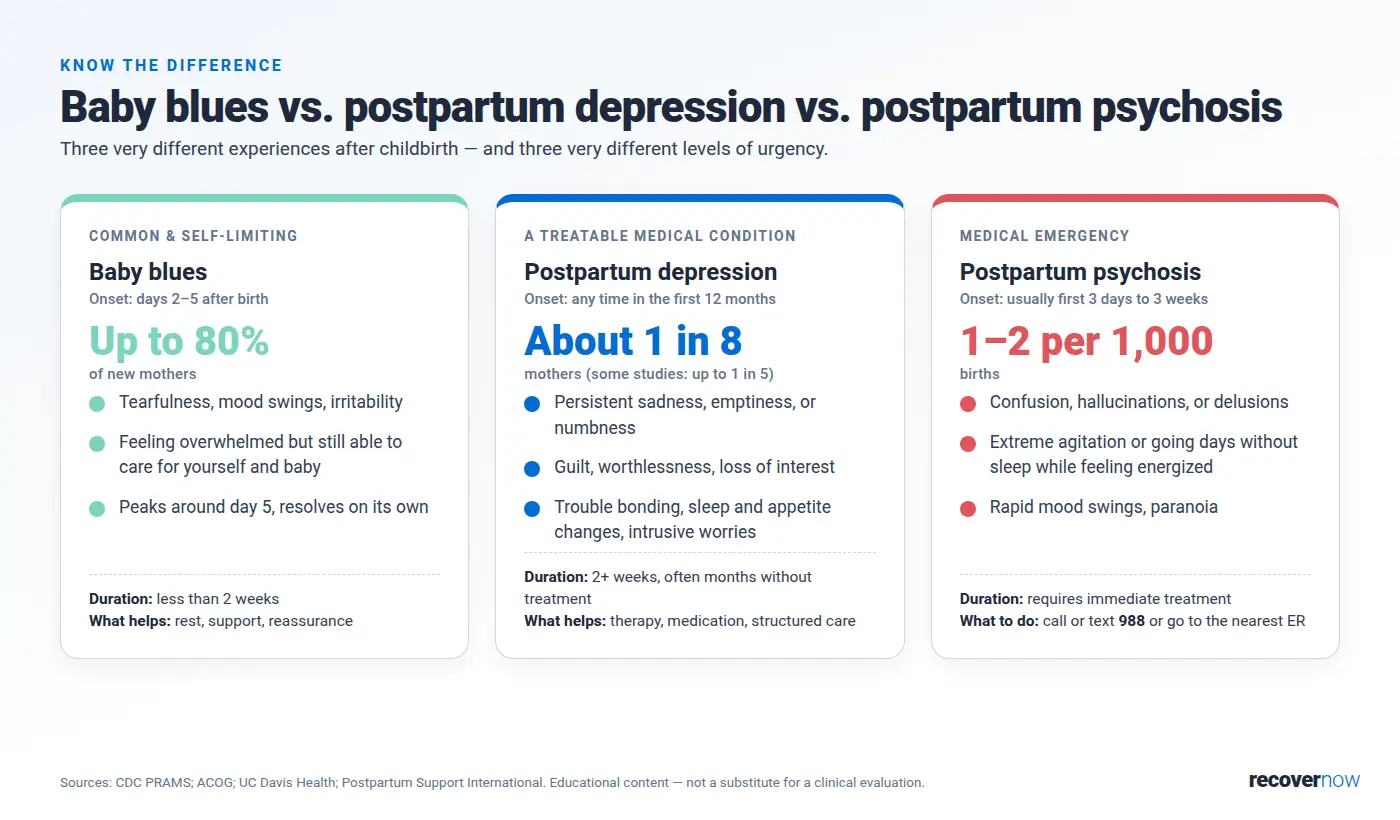
| Baby blues | Postpartum depression | Postpartum psychosis | |
|---|---|---|---|
| How common | Up to 80% of new mothers | About 1 in 8 (up to 1 in 5) | 1–2 per 1,000 births |
| Starts | Days 2–5 after birth | Any time in pregnancy or the first 12 months | Usually within 3 days to 3 weeks |
| Lasts | Under 2 weeks | 2+ weeks; months without treatment | Until treated |
| Core features | Tearfulness, mood swings, feeling overwhelmed but functioning | Persistent sadness or numbness, guilt, anxiety, sleep and appetite changes, trouble bonding | Confusion, hallucinations, delusions, severe agitation, going days without sleep |
| What to do | Rest, support, reassurance | Get screened and start treatment | Call or text 988 or go to the ER now |
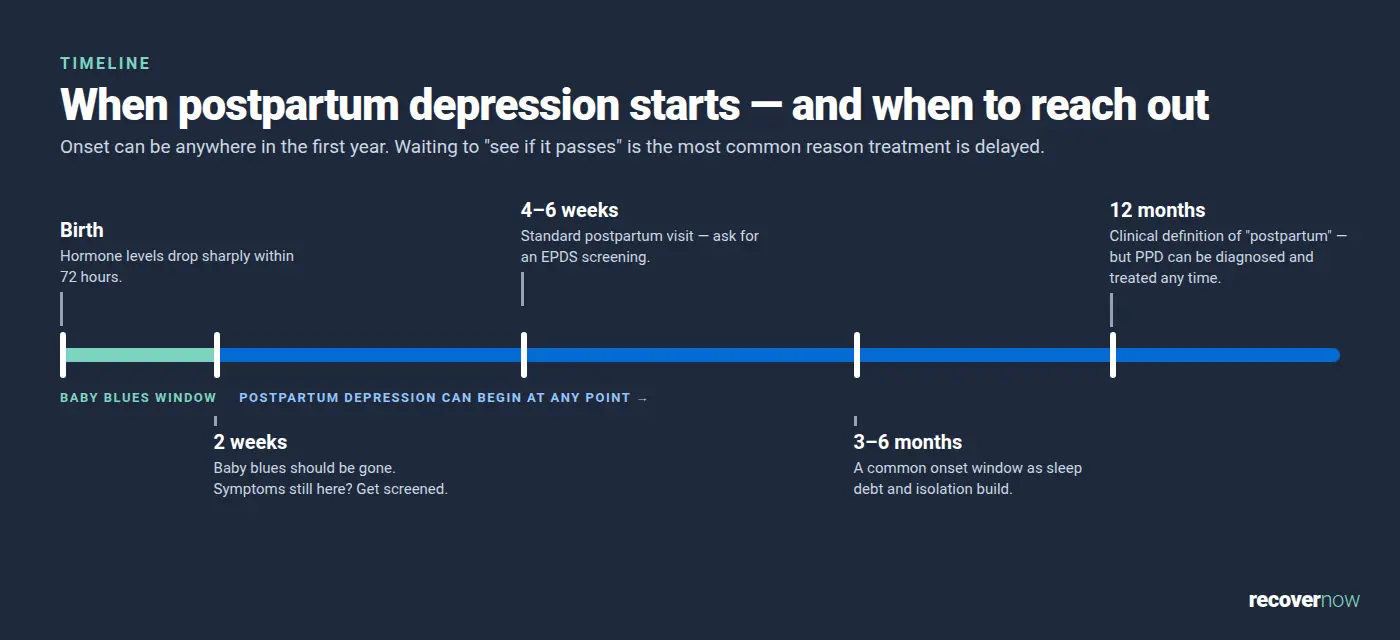
A useful rule: two weeks is the line. If low mood, anxiety, or emotional numbness is still present two weeks after delivery, or if it shows up later in the first year and doesn’t lift, it deserves a professional evaluation. You do not need to “wait and see” and you do not need to be at your worst to qualify for help. Our post on whether you’re “bad enough” for treatment speaks directly to that hesitation.
What postpartum depression looks like
PPD rarely looks like the sad, tearful picture most people expect. It often looks like irritability, rage, or anxiety. It can look like a parent who is “doing everything right” on the outside and feels nothing on the inside. It can look like someone who is terrified to be alone with their baby, not because they don’t love the baby, but because they’re afraid of the intrusive thoughts that show up when they are.
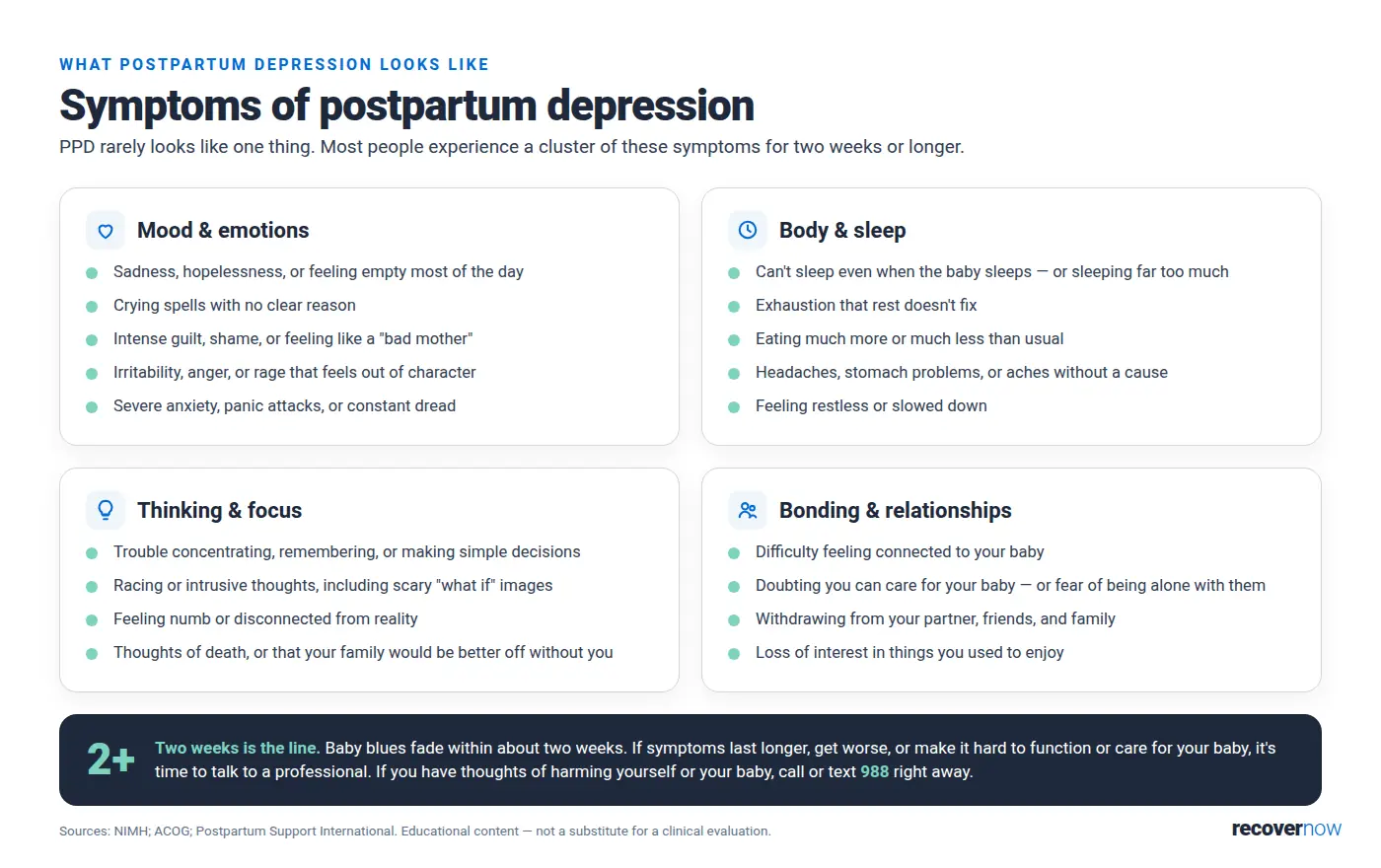
Emotional symptoms
- Sadness, hopelessness, or feeling empty most of the day, most days
- Crying spells that seem to come from nowhere
- Intense guilt, shame, or the belief that you are a “bad mother”
- Irritability, anger, or rage that feels out of character
- Severe anxiety, panic attacks, or a constant sense of dread (postpartum anxiety often travels with PPD)
- Feeling numb, flat, or disconnected from your own life
Physical symptoms
- Insomnia even when the baby is sleeping, or sleeping far more than usual
- Exhaustion that rest doesn’t fix
- Appetite changes: eating much more or much less than usual
- Headaches, stomach problems, or aches and pains without a clear cause
- Feeling physically restless or noticeably slowed down
Cognitive symptoms
- Trouble concentrating, remembering things, or making simple decisions
- Racing thoughts or intrusive, frightening “what if” images about harm coming to the baby
- Feeling detached from reality or “in a fog”
- Thoughts of death, or that your family would be better off without you
Relational and bonding symptoms
- Difficulty feeling connected to or interested in your baby
- Doubting your ability to care for your baby, or fear of being alone with them
- Withdrawing from your partner, friends, and family
- Loss of interest in activities you used to enjoy
A note on intrusive thoughts: many parents with PPD or postpartum anxiety experience unwanted, disturbing mental images of harm coming to their baby. These thoughts are distressing precisely because they are the opposite of what the parent wants. They are common, they are a symptom, and they are not the same as intent. Telling a clinician about them is the fastest route to relief. Thoughts that feel like a plan, a command, or that come with confusion or loss of contact with reality are different and require emergency care.
Postpartum depression in fathers and partners
Postpartum depression is not exclusive to birthing parents. Research consistently finds that roughly 1 in 10 fathers experiences depression in the first year after a child is born, with rates highest when the mother is also depressed. In partners it often shows up as withdrawal, irritability, working longer hours, or increased drinking rather than visible sadness. Recover Now’s family programs are built for exactly this situation, where more than one person in the household is struggling.
What causes postpartum depression?
There is no single cause. PPD emerges from a combination of biological changes, psychological history, and the social realities of caring for a newborn.
- Hormonal shifts. Estrogen and progesterone drop dramatically within about 72 hours of delivery. For people who are sensitive to those shifts, the drop can trigger depressive symptoms in the same way that severe premenstrual mood changes can.
- Sleep deprivation. Fragmented sleep is not just a side effect of new parenthood; it is an independent risk factor for depression and can make an existing episode worse.
- Personal or family history. A prior episode of depression, anxiety, bipolar disorder, or postpartum depression significantly raises the risk. A history of trauma, including a traumatic birth, also matters.
- Limited support. Isolation, a strained relationship, financial stress, or lack of practical help all raise the risk.
- Pregnancy and birth complications. A NICU stay, an emergency C-section, breastfeeding difficulties, or an unplanned pregnancy can all contribute.
- Co-occurring conditions. Eating disorders, substance use disorders, and thyroid conditions are all associated with higher rates of PPD. Postpartum thyroiditis in particular can mimic depression and should be ruled out with a simple blood test.
How postpartum depression is diagnosed
Diagnosis starts with a screening questionnaire and ends with a clinical conversation. The most widely used screening tool is the Edinburgh Postnatal Depression Scale (EPDS), a 10-question form that takes about five minutes. A score of 10 or higher is considered a positive screen, and a score of 13 or higher is often used to indicate probable depression. The American College of Obstetricians and Gynecologists (ACOG) recommends screening for depression and anxiety at least once during pregnancy and again at the postpartum visit.
A positive screen is not a diagnosis. A clinician (your OB-GYN, midwife, primary care provider, or a mental health professional at a program like Recover Now) will then ask about how long symptoms have lasted, how much they interfere with daily life, whether you have a history of mood disorders, and whether you’ve had any thoughts of harming yourself or your baby. Blood work to check thyroid function and rule out anemia is standard, because both can look a lot like depression.
You don’t have to wait for a scheduled postpartum visit to be screened. If you recognize yourself in the symptoms above, you can contact Recover Now directly and complete a confidential assessment by phone, usually the same day.
What treatment for postpartum depression looks like
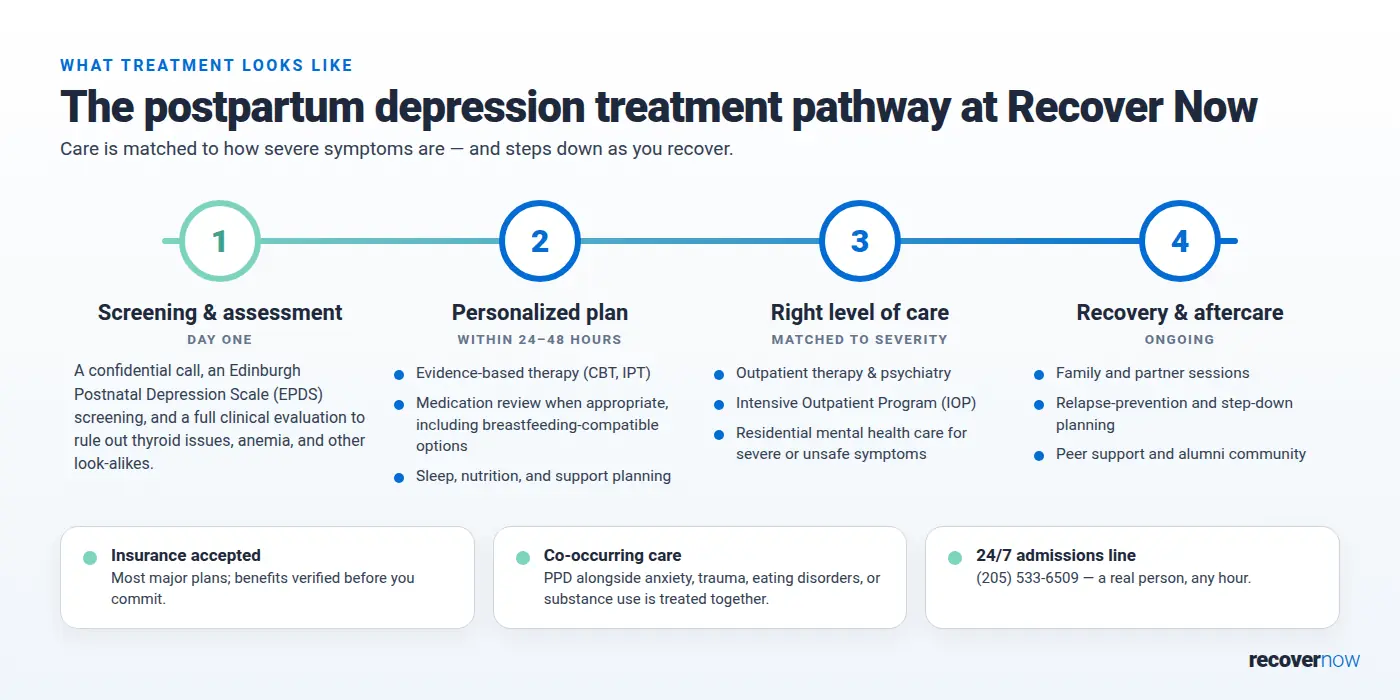
The good news is unambiguous: postpartum depression responds to treatment. Most people who receive appropriate care see meaningful improvement within weeks and full recovery within months. Treatment typically combines therapy, medication when appropriate, practical support, and the right level of care for how severe symptoms are.
Psychotherapy
Talk therapy is a first-line treatment for postpartum depression on its own for mild-to-moderate symptoms and alongside medication for more severe symptoms. Two approaches have the strongest evidence:
- Cognitive behavioral therapy (CBT) helps you identify and change the thought patterns that keep depression going, such as “I’m failing at this” or “a good mother wouldn’t feel this way,” and builds concrete skills for managing anxiety, sleep, and intrusive thoughts.
- Interpersonal therapy (IPT) focuses on the relationship changes and role transitions that come with a new baby, including changes with a partner, extended family, and your own identity.
At Recover Now, therapy happens in both individual and group formats. Group therapy with other parents who understand what you’re going through is often the moment people describe as the turning point, because the isolation of PPD is one of the things that keeps it alive.
Medication
Medication is a standard, safe, and often necessary part of treatment for moderate-to-severe postpartum depression. Current guidance from ACOG and other bodies recommends:
- SSRIs such as sertraline and escitalopram as first-line medications, both of which have a long safety record and are generally considered compatible with breastfeeding. Guidelines are explicit that withholding an antidepressant solely because someone is breastfeeding is not recommended.
- Zuranolone (Zurzuvae), the first oral medication specifically approved by the FDA for postpartum depression. It’s taken once daily for 14 days and works differently than traditional antidepressants, with many patients reporting improvement within the first few days. It’s an option for people who need rapid relief or who can’t tolerate SSRIs.
Medication decisions are made with a psychiatric provider who understands the perinatal period, taking into account breastfeeding, prior response to medication, and any co-occurring conditions. Recover Now’s clinical team coordinates directly with your OB-GYN or pediatrician when that’s helpful.
Levels of care at Recover Now
Not everyone with postpartum depression needs the same intensity of treatment. Recover Now’s treatment programs are structured so you can enter at the level that fits your symptoms and step down as you recover.
- Outpatient therapy and psychiatry. Weekly individual therapy, group sessions, and medication management for mild-to-moderate symptoms, scheduled around your baby’s needs. Learn more about outpatient care.
- Intensive Outpatient Program (IOP). Several hours of structured therapy multiple days per week for moderate-to-severe symptoms, while you continue to live at home. IOP is the most common level of care for postpartum depression because it provides real clinical intensity without separating you from your baby.
- Residential mental health treatment. For severe depression, safety concerns, or when outpatient care hasn’t been enough, 24-hour care in a home-like setting. Recover Now’s residential mental health program, Lotus Wellness in Nashville, Tennessee, offers residential care for depression, anxiety, trauma, and co-occurring disorders. Learn about residential treatment.
Treating what comes with postpartum depression
Postpartum depression rarely arrives alone. It often overlaps with postpartum anxiety or OCD, trauma from a difficult birth, an eating disorder that resurfaces under the stress of a changing body, or increased alcohol or substance use as a way to cope. Because Recover Now treats addiction, mental health conditions, and eating disorders across a single network, these can be addressed together rather than referring you between unrelated providers.
Whole-person and family support
Clinical care is paired with the things that make recovery stick: sleep planning, nutrition, mindfulness and movement, and family involvement. Partners and family members are brought into treatment through family programming, because the people around you need tools too, and because a supported household is one of the strongest predictors of lasting recovery.
You don’t have to wait until it gets worse.
A confidential conversation with our admissions team takes about 15 minutes. We’ll listen, answer your questions, and tell you honestly what level of care makes sense. Most major insurance plans are accepted.
What to expect when you call Recover Now
- A confidential conversation. An admissions specialist will ask about what you’ve been experiencing, your history, your support at home, and your baby. There is no judgment and nothing you say will surprise us.
- Insurance verification. We check your benefits and explain your coverage in plain language before you commit to anything. See our insurance page for accepted plans.
- Clinical assessment. A licensed clinician completes a full evaluation, including screening for depression, anxiety, trauma, and any co-occurring concerns, and recommends a level of care.
- A plan built around you and your baby. Scheduling, childcare logistics, breastfeeding, and family involvement are all worked into the plan from day one.
- Ongoing support. As symptoms improve, care steps down, and you leave with a relapse-prevention plan, connections to community support, and an open door if you ever need to come back.
You can also start online through our admissions page, or if you’re reading this on behalf of someone you love, through our help for someone else form. Healthcare providers can refer a patient directly.
Where to find postpartum depression treatment near you
Recover Now operates a network of treatment centers across the Southeast, so care is close to home for most families in the region. Explore locations by state: Alabama, Florida, Georgia, Louisiana, and Tennessee, or see the full locations directory.
Facilities in the Recover Now family include:
- Lotus Wellness — Nashville, TN. Residential mental health treatment for depression, anxiety, trauma, and co-occurring conditions.
- Recover Now Central Alabama — McCalla, AL. Outpatient programs and sober living serving the Birmingham area.
- Recover Now Greater Atlanta — Eatonton, GA. Residential treatment and detox in Atlanta.
- Longbranch Recovery — Abita Springs and Covington, LA. Residential and outpatient care, including a dedicated Recovery House for Women, serving the New Orleans area.
- Eating Disorder Treatment Center of Louisiana — Covington, LA. Specialized care when disordered eating and postpartum depression overlap.
- Chattanooga Recovery Center — Chattanooga, TN. Addiction and co-occurring mental health treatment.
- Grace Land Recovery — Cordova, TN (Memphis area). Addiction treatment with mental health support.
- Green Acres Wellness — Alapaha, GA. Residential addiction and wellness treatment in South Georgia.
- Tides Edge Detox — Jacksonville Beach, FL. Medical detox for parents whose substance use has escalated alongside postpartum depression.
Go deeper: Lotus Wellness has published a complete guide to postpartum depression treatment, and Eating Disorder Treatment Centers of Louisiana explains how postpartum depression and eating disorders overlap and how both are treated together.
Not sure which location is right? Take a virtual tour or call and we’ll match you to the closest program that treats what you’re experiencing.
Frequently asked questions about postpartum depression
How long does postpartum depression last?
Without treatment, postpartum depression commonly lasts many months and can persist beyond the first year. With treatment, most people notice improvement within four to eight weeks of starting therapy or medication, and many feel substantially recovered within three to six months. Newer medications such as zuranolone can produce improvement within days for some patients.
Can postpartum depression start months after birth?
Yes. Although the highest-risk window is the first three months, postpartum depression can begin at any point in the first year after delivery. Late onset is common when sleep debt, returning to work, weaning, or isolation build up over time.
Is it safe to take antidepressants while breastfeeding?
For most people, yes. SSRIs such as sertraline have been studied extensively in breastfeeding and transfer to milk in very small amounts. Current clinical guidance states that antidepressants should not be withheld or stopped solely because someone is breastfeeding. Your prescriber will weigh the specific medication, your history, and your baby’s health with you.
What is the difference between postpartum depression and postpartum anxiety?
Postpartum depression centers on low mood, loss of interest, guilt, and hopelessness. Postpartum anxiety centers on excessive worry, racing thoughts, physical tension, and often intrusive fears about the baby’s safety. They frequently occur together and are treated with the same core approaches: therapy, medication when appropriate, and structured support.
Does Recover Now treat postpartum depression?
Yes. Recover Now’s mental health programs treat depression, including postpartum depression, along with co-occurring anxiety, trauma, eating disorders, and substance use. Care is available at outpatient, intensive outpatient, and residential levels across Alabama, Florida, Georgia, Louisiana, and Tennessee. Call (205) 533-6509 to find the right program.
Does insurance cover postpartum depression treatment?
Most major insurance plans cover mental health treatment, including therapy, psychiatry, and intensive outpatient programs, under federal mental health parity laws. Recover Now verifies your benefits at no cost before treatment begins. Check your coverage here.
Can I bring my baby to treatment?
This depends on the program and level of care. Outpatient and intensive outpatient schedules are designed to work around infant care and feeding, and our admissions team will talk through childcare logistics with you on the first call. For residential care, we’ll help you plan for your baby’s care and build family visits and contact into your treatment plan.
What should I do if I think my partner has postpartum depression?
Say what you’re noticing without judgment, take over a concrete task (a night feeding, a meal, a nap), and offer to make the call with them. Recover Now’s help for someone else page walks through how to start that conversation, and our admissions team is happy to speak with family members first.
Sources and further reading
- Centers for Disease Control and Prevention — Depression Among Women
- National Institute of Mental Health — Perinatal Depression
- ACOG — Screening and Diagnosis of Mental Health Conditions During Pregnancy and Postpartum
- ACOG — Zuranolone for the Treatment of Postpartum Depression
- Policy Center for Maternal Mental Health — Maternal Mental Health Fact Sheet
- Postpartum Support International — HelpLine: 1-800-944-4773 (call or text “HELP” to 800-944-4773)
- 988 Suicide & Crisis Lifeline — call or text 988, 24/7
This article is for educational purposes and is not a substitute for a clinical evaluation. If you are in crisis, call or text 988 or go to the nearest emergency room.
