
Written and clinically reviewed by Amanda Kiner, LPC, LMHC, LCMHC, CPCS, NCC
The cost of rehab depends on three things: the level of care you need, how long you stay, and how your insurance covers it. Recover Now is a network of independently branded facilities offering addiction treatment across the Southeast, and one confidential call can tell you what your plan covers before you commit to anything.
TL;DR: There’s no single price for rehab. If you’re insured, your plan’s deductible, coinsurance and out-of-pocket maximum decide what you pay, and a free benefits check gives you that number fast.
Key takeaways
- Billed by level of care: Detox and residential cost the most per day.
- Your plan caps your costs: In 2026, in-network Marketplace limits are $10,600 (individual) and $21,200 (family).
- Accepted isn’t in network: Ask which one applies to your plan.
- Stepping down lowers cost: Each lower level of care usually costs less per day.
- Verify first: A free benefits check gives you your real number.
Ready for your number? It’s free and confidential, and you don’t have to commit to anything.
Call Now (205) 533-6509Verify Your Insurance
On this page
- Why there’s no single price for rehab
- How each level of care is billed
- What drives the price up or down
- How long rehab lasts, and why it matters for cost
- What you’ll actually pay with insurance
- Timing: why your plan year matters
- Paying for rehab with TRICARE or VA benefits
- Paying for rehab without insurance
- Ongoing costs to plan for after treatment
- How to find your out-of-pocket cost
- FAQs about rehab cost
- Find out what rehab would cost you
Why there’s no single price for rehab
Rehab doesn’t have one sticker price because programs are built and billed differently. A medically supervised detox stay and a weekly outpatient group are both “rehab,” but they use very different amounts of staff time, medical care and housing.
Online price ranges vary widely and rarely cite a primary source. For most insured people, the billed rate matters less than three numbers on their own plan: the deductible, the coinsurance and the out-of-pocket maximum.
Here’s how those pieces fit together:
- Billed charge: what the program lists for a day, week or session.
- Allowed amount: what your insurer agrees to pay for a covered service.
- Your share: the deductible, copays and coinsurance you pay on the allowed amount, up to your plan’s out-of-pocket maximum.
How each level of care is billed
Level of care is the biggest single driver of cost. The table below compares how each level is usually billed and why some cost more per day than others.
Table 1: How rehab is billed by level of care
| Level of care | What it is | How it’s usually billed | Relative cost per day | What raises the price |
|---|---|---|---|---|
| Medically supervised detox | Short-term care to manage withdrawal safely | Per day | Highest | Round-the-clock medical monitoring and medication |
| Residential treatment programs | Live-in care with full-day therapy | Per day | High | Housing, meals and daily clinical programming |
| Partial hospitalization program (PHP) | Full-day treatment, home at night | Per day or week | Moderate | Hours per day; ASAM criteria set PHP at 20 or more hours a week |
| Intensive outpatient program (IOP) | Several therapy sessions a week | Per session or week | Lower | Sessions per week; ASAM criteria set adult IOP at 9 or more hours a week |
| Standard outpatient rehab | Individual or group sessions | Per session | Lowest per visit | Session length and frequency |
| Sober living after treatment | Substance-free housing with peer support | Rent, weekly or monthly | Varies | Location and support services |
Medication-assisted treatment (MAT) adds medication and prescriber visits, and it’s usually billed alongside outpatient or another level of care. Sober living is housing rather than clinical care, so residents usually pay rent directly instead of billing health insurance.
What drives the price up or down
Beyond level of care, a handful of factors move your final cost. Some you can plan around, and others depend on your clinical needs.
Table 2: What changes the cost of rehab
| Factor | Why it matters | What to ask admissions |
|---|---|---|
| Length of stay | Daily rates add up, so more days means a larger total | How is length of stay decided, and when is it reviewed? |
| Clinical complexity | Co-occurring conditions need more clinician time | Can my mental health and substance use needs be treated together? |
| Medication needs | MAT adds prescriptions and prescriber visits | Is medication part of my plan, and how is it billed? |
| Network status | Out-of-network care usually costs you more and may not count toward your cap | Is this facility in network with my plan, or only accepting it? |
| Plan design | Deductible, coinsurance and caps differ by plan | How much of my deductible and cap have I met this year? |
| Prior authorization | Some plans won’t pay without approval first | Will you request prior authorization for me? |
If you’re living with depression, anxiety or trauma alongside substance use, ask about mental health treatment for co-occurring conditions. Treating both together can change which level of care fits you, and that changes the cost.
How long rehab lasts, and why it matters for cost
Length of treatment shapes your total cost more than almost anything else. In its Principles of Drug Addiction Treatment, the National Institute on Drug Abuse (NIDA) reports that most people need at least 3 months in treatment to significantly reduce or stop their drug use, and the best outcomes occur with longer durations.
Three months doesn’t mean three months of residential care. Many people move through a continuum, stepping down from detox or residential care into PHP, then IOP, then outpatient. Each step down usually costs less per day, so a longer total treatment period doesn’t have to mean the highest daily rate the whole time.
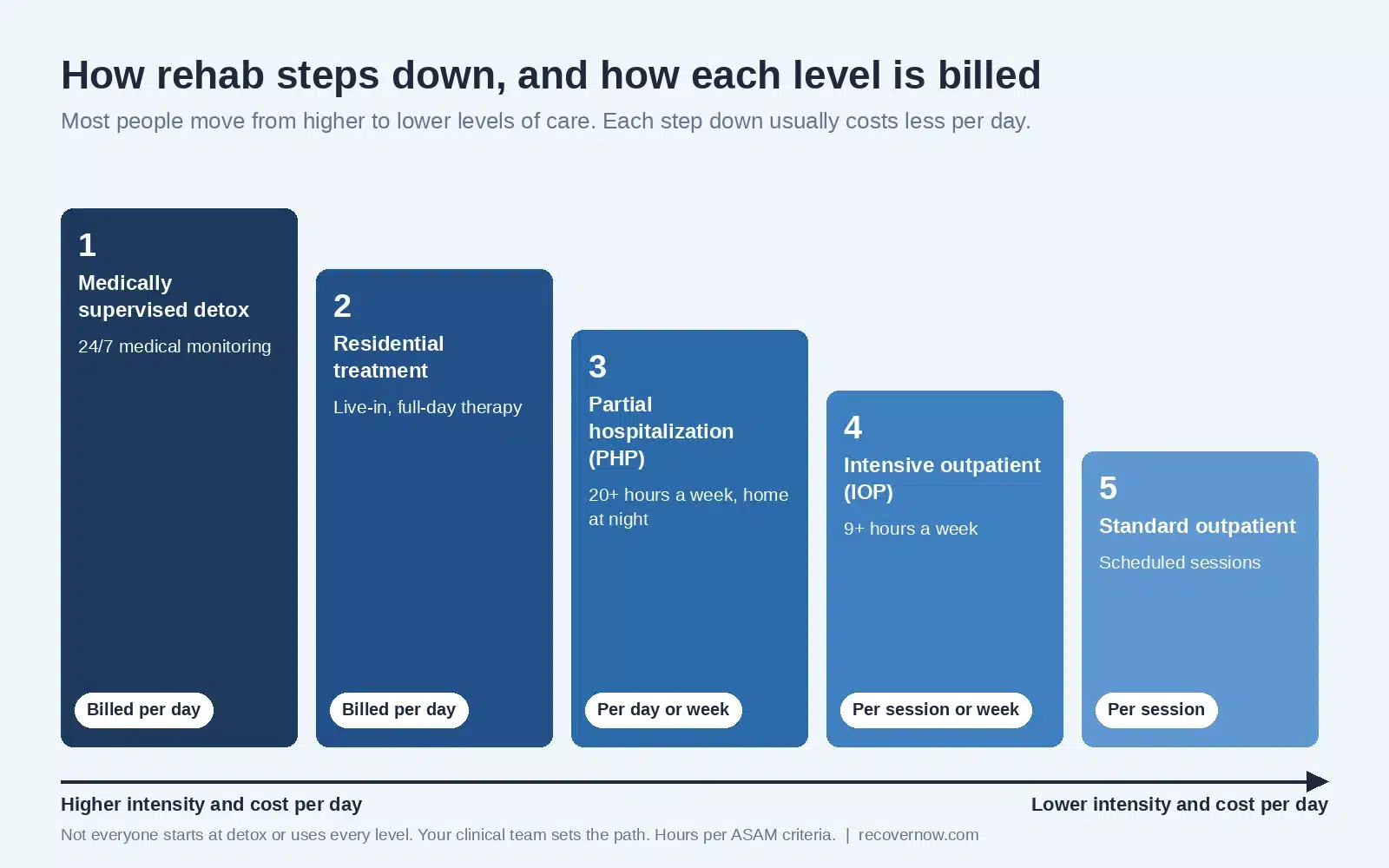
Your clinical team sets your length of stay based on your needs and progress. Ask how often your plan is reviewed and what stepping down would look like.
What you’ll actually pay with insurance
For most insured people, the real cost of rehab is their cost-sharing on covered, in-network care. Recover Now accepts most private insurance plans, including employer-sponsored and Marketplace plans, with network status confirmed during verification.
Accepted carriers include Blue Cross Blue Shield, Aetna, Cigna, Magellan and Carelon, among others. If you have Cigna, see how Cigna covers rehab for plan-specific questions.
The out-of-pocket maximum is your ceiling
According to HealthCare.gov’s definition of the out-of-pocket maximum, once you’ve spent your plan’s limit on deductibles, copays and coinsurance for in-network care, your plan pays 100% of covered benefits for the rest of the plan year. For 2026 Marketplace plans, that limit is no more than $10,600 for an individual or $21,200 for a family.
The cap has limits of its own. It doesn’t include your monthly premiums, services your plan doesn’t cover, out-of-network care, or charges above the allowed amount a provider may bill.
A worked example
Say your plan has a $3,000 deductible, 20% coinsurance and a $7,500 out-of-pocket maximum. You’d pay the first $3,000 of covered, in-network charges, then 20% of the allowed amount after that.
Once your deductible, copays and coinsurance add up to $7,500 for the year, your plan pays 100% of covered in-network care. No matter how long a covered stay runs, your in-network cost-sharing for that plan year stops at $7,500.
Prior authorization
Many plans require approval before residential care or detox. The admissions team contacts your insurer and requests prior authorization for you, so you don’t have to manage the paperwork. Approval isn’t automatic, which is why it helps to start early.
Timing: why your plan year matters
Deductibles and out-of-pocket maximums usually reset at the start of each plan year. For Marketplace plans and many employer plans, that’s January 1, but some employer plans run on a different calendar.
If you’ve already met much of your deductible this year, covered care before the reset may cost you less out of pocket. If you’re starting fresh, you’ll pay toward the new year’s deductible first.
Don’t let the calendar decide whether you get care. If you need help now, reach out today and ask admissions how timing affects your costs.
What changes in 2027
HealthCare.gov lists the 2027 Marketplace out-of-pocket limit at no more than $12,000 for an individual or $24,000 for a family, up from $10,600 and $21,200 in 2026. A higher cap means your worst-case cost-sharing for the year can be higher.
If you’re choosing or renewing a plan for 2027, check three things before you enroll:
- Whether the plan covers substance use and mental health treatment at the levels of care you may need.
- Whether the facilities you’re considering accept the plan and are in network with it.
- The plan’s deductible and out-of-pocket maximum, not just the monthly premium.
Paying for rehab with TRICARE or VA benefits
Recover Now accepts TRICARE at most facilities in the network, and admissions confirms which ones fit your benefits. TRICARE requires prior authorization for residential substance use disorder treatment, and admissions handles that request for you.
VA benefits are accepted at select facilities in the network. If you’re using VA community care, VA generally needs to authorize care before it starts, so begin with a benefits check and your VA care team.
Paying for rehab without insurance
If you don’t have insurance, or prefer not to use it, private pay is available. Rates depend on level of care and length of stay, which the clinical team sets after a complimentary phone assessment.
Other lower-cost options exist outside the network. FindTreatment.gov, run by the Substance Abuse and Mental Health Services Administration (SAMHSA), lets you search providers by payment options, including sliding fee scales.
For a full rundown of insurance, private pay and employer benefits, see these ways to pay for rehab.
Ongoing costs to plan for after treatment
Treatment doesn’t end at discharge, and neither do the costs. Plan for these recurring expenses as you step down:
- Outpatient therapy copays or coinsurance
- Prescription refills, if medication is part of your plan
- Sober living rent, if you choose recovery housing
- Travel to and from appointments
Ask admissions to walk you through what continuing care usually involves at the level you’re starting with.
How to find your out-of-pocket cost
The fastest way to your real number is a free, confidential benefits check. Here’s how it works:
- Gather your card. Have your member ID, group number and the name on the policy ready.
- Call or submit the form. Call (205) 533-6509 any time, or submit the verification form. Admissions usually follows up within five minutes of a form submission.
- Ask the right questions. Use the checklist below so nothing gets missed.
- Let admissions request authorization. If your plan requires prior authorization, admissions requests it for you.
- Complete a clinical assessment. The clinical team recommends a level of care and length of stay, which sets your cost.
Questions to ask about your coverage
- Does my plan cover detox, residential, PHP, IOP and outpatient treatment?
- Is the facility in network with my plan, or does it only accept it?
- How much of my deductible and out-of-pocket maximum have I met this year?
- What’s my copay or coinsurance for each level of care?
- Is prior authorization required, and for which levels of care?
Checking benefits for a loved one
You can start this process for someone else. Admissions can check benefits on their behalf, which can make the first conversation easier. If you’re not sure how to bring it up, these tips for talking with a loved one about getting help may be useful.
FAQs about rehab cost
Quick answers to the questions people ask most about paying for rehab.
How much does 1 month of rehab cost?
It depends on the level of care and your plan. A month of residential care costs more than a month of outpatient care because it includes housing, meals and full-day programming. If you’re insured, your in-network cost-sharing for a 2026 Marketplace plan year can’t exceed $10,600 for an individual.
How much does 2 weeks of rehab cost?
Two weeks of detox or residential care is billed per day, so the total depends on the daily rate and your plan’s cost-sharing. Two weeks of IOP or outpatient care is billed by session or week and usually costs less. A benefits check gives you the number for your plan.
Does insurance cover rehab?
Many private plans cover substance use and mental health treatment, but coverage varies by plan, level of care and network status. Recover Now accepts most private insurance plans, including employer-sponsored and Marketplace plans, and confirms your coverage during a free verification.
Is rehab free if I have insurance?
Rarely. Most plans require you to pay a deductible, copays or coinsurance before they cover the rest. Your plan’s out-of-pocket maximum limits how much you pay for covered in-network care in a plan year.
How long does insurance verification take?
Admissions usually follows up within five minutes of a verification form submission. Prior authorization, when your plan requires it, can take longer because it depends on your insurer.
Can I check benefits for someone else?
Yes. Admissions can check benefits on a loved one’s behalf. Have their insurance card information ready when you call.
Does insurance pay for sober living?
Sober living is housing rather than clinical treatment, so residents usually pay rent directly. Outpatient therapy you attend while living there may still be covered by your plan.
What does the daily rate for residential rehab include?
A residential daily rate usually covers housing, meals, group and individual therapy, and clinical oversight. Ask what’s included at the facility you’re considering, since medication and outside medical services can be billed separately.
Find out what rehab would cost you
You don’t have to figure out the cost of rehab alone, and you don’t have to commit to anything to get your number. One confidential call connects you to facilities across Alabama, Florida, Georgia, Louisiana and Tennessee.
Call for a free benefits check, verify your insurance online, or contact the Recover Now admissions team with questions. Don’t wait for tomorrow. Recover Now.
Call Now (205) 533-6509Verify Your InsuranceFind a Location
This content is for informational purposes only and isn’t a substitute for professional medical advice, diagnosis or treatment. If you’re in crisis, call or text 988 to reach the 988 Suicide & Crisis Lifeline.
